In the current post-pandemic era, after repeated rounds of consolidation and integration, the domestic printing and packaging industry continues to emphasize that strengthening on-site production management remains critically important for printing enterprises, as competitiveness still originates from the production floor. However, many printing and packaging enterprises still remain in extensive production modes, neglecting effective on-site management and control, resulting in substantial business volume but minimal profits, or even陷入 continuous internal consumption. By strengthening on-site management and control, enterprises can create production floors characterized by low cost, low consumption, high efficiency, high quality, and orderly production, thereby achieving profit maximization, improving employee quality, building excellent corporate culture, and enhancing enterprise competitiveness.
In printing and packaging enterprises, an excellent production floor must possess the following characteristics: reasonable personnel allocation, orderly placement of materials and tools, clear on-site planning, well-organized workflows, clean on-site environment, normal equipment operation, and balanced product quality and performance. From this, we can conclude that the core of on-site management consists of: man, machine, material, method, and environment, abbreviated as "4M1E" or "5M." Specific on-site management can be divided into six components: personnel management, production management, quality management, equipment management, safety management, and cost management. Printing enterprises should proceed from these six management components, applying appropriate management tools and methods for assistance, to ensure effective implementation and long-term maintenance of on-site production management.
Basic Content of On-Site Management '5S' and 'PDCA'
1. On-Site '5S' Management Method
Based on the six basic management components, Toyota Motor Corporation of Japan developed the '5S On-Site Management Method,' consisting of five modules: 'Seiri' (Sort), 'Seiton' (Set in Order), 'Seiso' (Shine), 'Seiketsu' (Standardize), and 'Shitsuke' (Sustain). The content of '5S' management is shown in Table 1:
Table 1: Summary of '5S' Management Operation Items
2. On-Site 'PDCA' Management Cycle
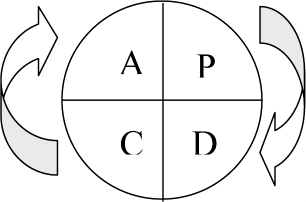
The 'PDCA Management Cycle,' also known as the Deming Cycle. The 'PDCA' model is shown in Figure 1.
Figure 1: 'PDCA' Management Cycle Model Diagra
The 'PDCA' model consists of four components: Plan, Do, Check, and Action. This method divides enterprise operations and production management into several cyclic processes, addressing one or several problems within each cycle. Problems that remain unsolved or newly emerging issues are addressed in the next 'PDCA' cycle. With each completed cycle, work advances one step further, and management capabilities are correspondingly improved.
When printing and packaging enterprises introduce the '5S' management method and 'PDCA' management cycle method and integrate their application, the current state of the manufacturing floor will be significantly improved and enhanced, product quality can be improved, and the goals of high quality, high efficiency, low consumption, balanced production, safety, and civilized production can be achieved.
Integrated Application of '5S' Management and 'PDCA'—5SPDCA
When enterprises implement '5S' management, various complex problems are encountered in every S management环节, and the root causes of these problems are intricate and complex. To address this, managers can apply the 'PDCA' cycle management method in every S management环节 to solve problems through successive cycles. When analyzing each problem, tools such as cause-and-effect diagrams are used for in-depth analysis to quickly identify root causes and resolve them.
3. Integrated Application of the Sort (Seiri) Phase with 'PDCA'
The primary issue in the Sort phase is distinguishing on-site items. Without a quantitative concept, the purpose of the Sort phase cannot be achieved. Managers can apply the 'PDCA' management cycle method.
In the P phase, plans are formulated based on item usage frequency to determine necessity. If items are used daily, they are placed within immediate reach of on-site employees; if used once a week to once a month, they are placed near the usage location; if used once a month to once every three months, they are placed around the workplace; if used once every three months to six months, they are placed in the warehouse; if used less than once every six months or not at all, they are discarded.
In the D phase, the site is organized and items are relocated according to the plan established in P.
The C phase involves checking the execution results of the plan in the D phase.
The A phase involves summarizing successful experiences, establishing standards, and transferring unresolved problems to the next 'PDCA' Sort phase.
In the 'PDCA' Sort phase, managers can implement the 'Red Tag Campaign' method,即 placing red tags on items requiring further evaluation. Items with red tags enter the next 'PDCA' Sort phase. This not only improves sorting efficiency but also avoids unnecessary losses caused by misjudgment due to insufficient information.
4. Integrated Application of the Set in Order (Seiton) Phase with 'PDCA'
The 'PDCA' Set in Order phase follows the principles of 'fixed location, fixed container, fixed quantity,' and conducts 'PDCA' Set in Order analysis of on-site order based on the three elements of 'location, method, identification.' In 'PDCA' Set in Order:
1)P involves analyzing the '3 fixes' and making plans. Specifically, fixed location means placing frequently used items near work locations and using color-coded identification to demarcate item storage areas, with different colors representing different functions; fixed container means determining appropriate containers for different items based on their characteristics and usage conditions; fixed quantity means determining a reasonable fluctuation range for item quantities based on actual on-site conditions, neither delaying production efficiency nor affecting on-site order, achieving maximum benefits in work efficiency and quality.
2)The D phase involves implementation according to the '3 fixes' principles and the plan from the P phase. For example, in fixed location, red and green lines can be used to distinguish whether finished products are qualified. Fixed container involves adding external identification to containers to ensure orderly on-site placement. For individual items, managers can adopt the 'Shadow Board Management' method,即 outlining item shapes at storage locations and placing items on corresponding patterns. Standardized storage reduces search time for users and prevents random placement, improving work efficiency.
3)The C phase involves verifying the effectiveness of the D phase.
4)The A phase involves standardizing and institutionalizing successful experiences from the above actions, and transferring unresolved problems to the next 'PDCA' Set in Order phase.
5. Integrated Application of the Shine (Seiso) Phase with 'PDCA'
1)When on-site managers encounter problems during 'Shine' activities on the production floor, they can conduct problem analysis and propose solutions in the P phase. Causal diagrams can be used for problem analysis. The specific steps are as follows:
Step 1: Analyze the main characteristics of the problem and identify major directional causes (see Figure 2).
Figure 2: Application Example of Causal Diagram
Step 2: Conduct detailed cause analysis for major directional causes (see Figure 2.1).
Figure 2.1: Detailed Cause Analysis
Step 3: Identify the primary influencing causes based on the degree of impact of major directional causes and mark them (see Figure 2.2).
Figure 2.2: Primary Influencing Causes
Step 4: Conduct further analysis of the marked causes to identify root causes.
2)In the D phase, managers can establish regulations assigning responsibilities, such as allocating cleaning areas to individuals, with each person responsible for cleaning their own work area and conducting daily equipment inspections.
3)The C phase involves inspection and verification of the D phase, comparing results with planned objectives to identify existing problems.
4)The focus of the A phase is to formulate corresponding operating standards and procedures for frequently occurring problems, ensuring there are rules to follow in future work. Additionally, unresolved problems are transferred to the next 'PDCA' cycle.
6. Integrated Application of the Standardize (Seiketsu) Phase with 'PDCA'
In the 'PDCA' Standardize phase, the focus is on institutionalization and sustainability. Only under standardized and reasonable systems can the effectiveness of the preceding '3S' management phases be maintained.
Relevant criteria are formulated based on actual on-site conditions and implemented in the D phase. For example, assessing whether on-site items are properly placed; strengthening inspections of production floors to maintain employee enthusiasm in management. Furthermore, managers can introduce the 'Visual Management' method to assist in implementing the 'PDCA' Standardize phase, utilizing intuitive visual perception information with appropriate colors to organize on-site activities, making them immediately understandable to most people. For instance, marking maximum and minimum capacity points on liquid containers; installing warning lights at intersections in workshops to prevent accidents; attaching red ribbons to motor heat dissipators to visually identify which machines are operating. In the C phase, progress boards are hung on some products, implementing 'Kanban Management,' enabling employees to obtain timely feedback on production progress and content. Managers should fully leverage visual management methods, encouraging employees to jointly improve the work environment and making potential information visible. Finally, experiences from previous processes are summarized and institutionalized.
7. Integrated Application of the Sustain (Shitsuke) Phase with 'PDCA'
The core component of '5S' management is the Sustain phase. Since the object of sustain management is people, and people are the most important resource of an enterprise, managers should develop a step-by-step improvement plan based on the actual conditions of their own employees and management levels. For example, first changing employees' appearance and work environment, then changing their mental state, cultivating corporate culture among employees, and finally correcting employees' work attitudes, etc.
When implementing plans in the D phase, managers gradually change employees' thinking and habits through daily management, working in accordance with prescribed procedures. Concentrated cultivation can also be conducted through morning meetings. In morning meetings, managers can check employee attendance, understand employees' mental and work status for the day, announce daily work tasks and precautions, and conduct quality education for most employees during the meeting. Managers must also constantly verify implementation effectiveness, recording successful experiences and deficiencies to form documentation, laying the foundation for future enterprise development.
Implementation and Measures for Integrated Application of '5S' and 'PDCA' in Printing and Packaging Enterprises
8. Integrated Application Implementation
For a formal, strategically developing small and medium-sized manufacturing enterprise aiming to cultivate core competitiveness, the Standardize and Sustain phases should be continuously implemented and executed long-term to obtain the benefits brought by '5S' management. For large manufacturing enterprises, in addition to implementing '5S' management, they should also focus on corporate culture construction, positioning the enterprise at a level that contributes to and influences society, actively assuming certain social responsibilities while obtaining economic benefits. Various types of enterprises and their management contents can be represented in Figure 3.
Figure 3: Relationship Emphasis Diagram of Various Types of Printing and Packaging Enterprises and '5S' Management Contents
Comprehensively speaking, '5S' management and 'PDCA' management cycles are highly effective tools for improving production floor environments and product quality in the printing industry. However, during internal enterprise implementation, they may encounter obstacles from subjective or objective factors. Therefore, printing enterprises should plan implementation work in advance when promoting '5S' management or 'PDCA' cycle management.
1)Establish a management implementation team, which may include on-site managers and administrative experts, and provide appropriate education and training for the implementation team.
2)Based on actual production floor conditions, the implementation team should establish draft management systems along with detailed implementation procedures and precautions.
3)Convene an implementation conference to introduce the management methods and concepts to be implemented to all employees, discuss scheme revisions with them, and demonstrate top management's determination to implement these management methods.
4)Implement management schemes on the production floor, establish evaluation and reward-punishment methods, and conduct rewards and punishments after assessing employee behaviors and products. This corrects and strengthens employee emphasis on implementing these management methods.
5)Timely revise management methods according to actual enterprise development conditions to continuously improve them. The production floor of a printing and packaging enterprise is a comprehensive reflection of corporate image, management level, product quality, and spiritual outlook, serving as an important indicator of an enterprise's comprehensive quality level. Implementing '5S' production floor management and 'PDCA' cycle management methods and integrating their application helps enterprises improve product quality, employee quality, and corporate competitiveness, holding significant importance for achieving profit maximization goals, enhancing economic benefits, and strengthening competitive strength.
References:
[1] Sun Linyan, Yang Caijun. Service Transformation Strategy for Chinese Manufacturing Enterprises [M]. Tsinghua University Press, 2011.
[2] Yang Jian, Huang Ying. Excellent Team Leader On-Site Management [M]. China Textile Press, 2010.
[3] Dang Xinmin, Su Yingbin, Lan Xuri. Efficiency Improvement Techniques for Manufacturing Industry [M]. Peking University Press, 2007.
[4] Xiao Zhijun. Three Major Tools for On-Site Management [J]. Enterprise Management, 2003 (11): 64-70.
[5] Lei Qingyou, Zhu Wan, Chen Qingguo, Hu Dalong. Revisiting 5S: Factory On-Site Management and Improvement [J]. Internal Combustion Engine Parts, 2007 (6): 44-47.
[6] Su Jing, Zhang Changliang. Exploring Effective Methods for Integrating PDCA into Quality Management Systems [J]. Enterprise Management, 2012 (30): 56-58.
[7] Li Ji. Discussion on On-Site Management Issues in Manufacturing Enterprises [J]. Journal of Xiamen University, 2003 (42): 66-71.
Previous article:A Brief Discussion on Lean Production Planning in the Printing In...
Next article:The SWOT Analysis Method: Introduction to 9 Classic Business Stra...

This is a promotional slogan